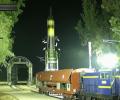
India successfully test fired the Agni-Prime missile from a rail-based mobile launcher. The next-generation missile has a range of up to 2,000 kilometers and advanced features.

The largest tranche came in July, in the wake of Operation Sindoor, with the DAC according acceptance of necessity -- or initial approval -- for 10 capital acquisition proposals amounting to approximately 1.05 trillion through indigenous sourcing.
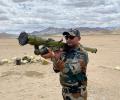
The new supplies of the Igla-S air defence missiles have been received by the Indian Army a couple of weeks ago and are being provided to the forward formations for taking care of the threat from enemy fighter aircraft, choppers and drones on the borders.

India's premier defence research organisation DRDO has awarded seven new projects to private entities to develop key military assets including underwater launched unmanned aerial vehicle and long-range remotely operated systems.

'Some success has been achieved in raising the costs of terrorism for Pakistan.'

According to the DRDO chairman, the BrahMos missile, primarily launched from Sukhoi Mk 1, was used during the offensive phase.
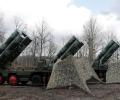
The Indian side would prefer to get S-500 air defence system which has more range than the S-400 but it would require a clearance from the top Russian leadership for its sale, they said.

Drawing lessons from security protocols of Parliament, the state is working closely with agencies like the Defence Research and Development Organisation and the Electronics Corporation of India Ltd to design a multi-layered safety mechanism.

India successfully test-fired nuclear-capable short range ballistic missiles Prithvi-II and Agni-I from an integrated test range off the Odisha coast, demonstrating its strategic deterrence capability. The test-firing of the missiles, conducted by the elite Strategic Forces Command, validated all operational and technical parameters.
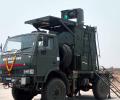
'DRDO is working on a number of technologies that will give India Star Wars capability.'

The flight test fully met all the trial objectives validating complete network centric warfare weapon system, the defence ministry said.

Putin's State visit will centre on fixing the huge India-Russia trade imbalance, with both sides pushing to lower duties, ease non-tariff barriers, and seal a landmark mobility pact to send more Indian workers to Russia.

'Government officials use Gmail and ordinary phones without basic security consciousness.' 'Interoperability, especially in joint exercises with countries like the US, worries me.' 'It often means we open our systems to them, but they don't reciprocate.' 'They could have kill switches in their systems and might even be able to affect ours.'
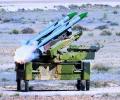
Military officials detail how the Indian Air Force's downing of a Pakistani aircraft at a long distance reflects its air superiority and dealt a psychological blow to the adversary.

Indian astronaut Shubhanshu Shukla will enjoy a range of Indian dishes, including rice varieties, moong dal halwa, and mango nectar, during his 14-day mission aboard the International Space Station (ISS). He will also have the option to choose from international cuisine, as approved by NASA. ISRO and DRDO have developed the Indian food options for astronauts of the Gaganyaan mission and Shukla will be able to savor them with NASA's approval.

Prime Minister Narendra Modi is likely to visit the United Kingdom by the end of this month, with the India-UK free trade deal expected to be formally signed. Discussions on expanding bilateral ties in defence and security are also anticipated.

'The natural barrier that is Aravalli, you are demolishing it, then who will stop the desert?' 'In future, I predict that people will roam around with oxygen cylinders in Delhi because they won't be able to breathe.'

The extended range of the missile which is part of the Strategic Forces Command will give a variety of options to the planners during times of conflict.
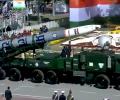
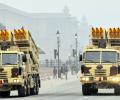
India showcased its indigenous short-range tactical missile Pralay for the first time at the Republic Day parade on Sunday. The missile, developed by the Defence Research and Development Organisation (DRDO), is capable of carrying a nuclear warhead and has a range of 150 to 500 kms. The parade featured an array of other indigenously built missiles, surveillance systems, and weapon systems, reflecting India's growing military prowess. The DRDO displayed its latest innovations for national security, including the quick reaction surface-to-air missile, airborne early warning and control system, and drone detect, deter and destroy system.
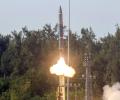
The solid-fuel, battlefield missile developed by Defence Research Development Organisation is based on Prithvi Defence Vehicle from the Indian ballistic missile programme.

This MRSAM version is a surface-to-air missile developed jointly by DRDO and Israel Aerospace Industries for use by the Indian Army.

Beijing's latest weapon, 15 times more powerful than TNT, signals a new frontier in high-impact, non-nuclear military technology.
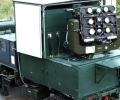
Success has put India in the exclusive and limited club of nations that possess the high-power Laser-DEW.
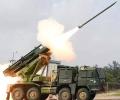
'A crucial role in bolstering the Indian Army's firepower by enabling precise and long-range strikes.'
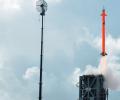
In a bid to galvanise its air defence capabilities, India on Tuesday successfully test fired a new, long range surface-to-air missile jointly developed with Israel from a defence base off Odisha coast.

After being launched, the glide bomb steer towards the target using a highly accurate hybrid navigation scheme, the ministry said.

The Enhanced Pinaka has demonstrated a range of 75 km and an ability to strike within 10 metres of where it is aimed. This allows a Pinaka battery to destroy a terrorist camp, or an enemy post, logistics dump or headquarters, without sending soldiers across the border.

On both the occasions, the missiles intercepted the simulated targets with pinpoint accuracy. The missiles were tested for minimum and maximum range.
'If you take any ministry of defence project, Nibe is up there, getting orders.'

In a major boost to its military might, India on Wednesday successfully test-fired surface-to-surface strategic missile Agni-5 that can strike targets at ranges up to 5,000 km with a very high degree of accuracy, officials said.
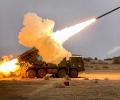
The rocket systems that were tested at Pokharan field firing ranges were manufactured by a private industry following transfer of technology by the Defence Research and Development Organisation.
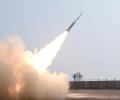
The Defence Research and Development Organisation on Friday successfully conducted a flight test of Solid Fuel Ducted Ramjet (SFDR) technology in Odisha, official sources said.

In a double-dose bid to boost growth and employment prospects, the Union Cabinet on Tuesday approved a Rs 2.07 trillion outlay for a research development and innovation (RDI) Scheme to fund private sector innovations, and an employment-linked incentive (ELI) to create over 35 million new jobs over the next two years.

The missile showcased its precision and capability to neutralise targets, the statement said.

India on Monday successfully test-fired its indigenously built nuclear-capable intermediate range Agni-I ballistic missile, capable of hitting a target 700 km away, from a test range off Odisha coast as part of a user trial by the Army.

The Indian Navy, which was earlier looking towards the US for design expertise, technical know-how and operational practices, is now considering the advantages of working with the Royal Navy.

The missile was fired from a ground mobile launcher at launch pad number-1 of the Integrated Test Range (ITR) near here at 3.55 pm, and it hit the target with accuracy, the sources said.

The defence ministry said the missiles destroyed the targets with precision at two different ranges.

The interceptor, known as Advanced Air Defence missile, was engaged against an electronically prepared target which simulated the trajectory of a hostile ballistic missile.

Nibe Space (NSPL), a subsidiary of Nibe, announced its vision to establish India's first multi-sensor, all-weather, high-revisit Earth observation satellite constellation. Aiming to strengthen India's self-reliance in the strategically crucial defence-space sector, NSPL signed memoranda of agreement with Indian and global partners, including Larsen & Toubro, Centum, AgniKul, Skyroot Aerospace, SpaceFields, SISIR Radar, CYRAN AI Solutions, and Thales Alenia Space as a technology partner.
 © 2026 Rediff.com - Advertise with us - Disclaimer - Privacy Policy - Sitemap - Feedback - About us - Terms of use - Grievances